


 was founded in 1996 in Rochester, New York, as the Men of Color Health Awareness Project, which specifically addressed HIV/AIDS health concerns that are affecting gay men, including young people and women through their expanded programming services that emphasize wellness, individual responsibility, increased awareness. These advertisements "I am gay" are part of the 2009 "We are part of you" campaign to promote awareness of the African American male gay population.


 studied graphic design in Pittsburgh and then continued at the School of Visual Arts in New York. He tried many disciplines as collage, painting, installations, videos, but his best form of expression was drawing. In the East Village of New York he discovered the burgeoning alternative culture of the 1980s, outside galleries and museums,
  its expressions developed into new territory: streets, subways and warehouses. He met artists from the underground New York life as Kenny Scharf and Jean-Michel Basquiat, with whom he organized exhibitions and
  performances at Club 57, which became the favorite place of the avant-garde. This is where the radiant baby, one of the best-known symbols of the artist, was born. Inspired by graffiti and anxious to reach a wide audience, Haring began drawing with white chalk
  in the subways of NY and on the sidewalks in the East Village where they are still present today. Drawings have energetic and rhythmic lines, the infinite repetition of synthetic forms outlined in black with bright colors in a variety of formats.
  In 1982 he had his first solo exhibition in the Tony Shafrazi Gallery; the same year took part in the international art Fair Doc umenta in Kassel, Germany. In 1983 he took part in the Whitney Museum Biennial and got to know
  Andy Warhol, his friendship with Warhol would prove to be a decisive element in his eventual success, particularly after their deaths. In few years Haring visited and worked in Melbourne and Sidney, Rio de Janeiro, Minneapolis, Amsterdam, Berlin, Italy. In 1985 Haring started to paint canvas; painted the body of
 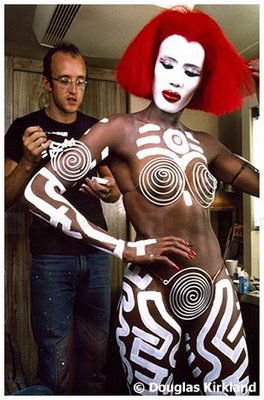 Grace Jones for her music video, opened a retail store in SoHo, selling merchandise bearing his iconic images including t-shirts, toys, posters and other objects with reproductions of his art;
  the shop closed in 2005. Haring also created advertising images for Absolut vodka and Swatch watches. By the arrival of the store, his work began reflecting more socio-political themes, such as
  racism, AIDS and
  drugs diffusion. In 1988, Haring was diagnosed with AIDS. He established the Keith Haring Foundation in 1989, its mandate being to provide funding and imagery to AIDS organizations and children's programs, and to expand the audience for Haring’s work through exhibitions, publications and the licensing of his images.
  In June 1989, on the rear wall of the convent of the Church of Sant'Antonio in Pisa, Italy, he painted the last public work of his life, a mural titled "Tuttomondo".


 http://www.haring.com/
 I comportamenti per la prevenzione del rischio di trasmissione del virus Hiv sono ormai noti, ma non per questo sono adottati: il profilattico è poco utilizzato rispetto al resto d’Europa (l’Italia è agli ultimi posti) e il rapporto sessuale non protetto è la prima causa di infezione in Italia. I casi di diagnosi di infezione da Hiv attribuibili a trasmissione sessuale sono aumentati dal 13,3% del 1998 al 79% del 2009. Anche rispetto alle diagnosi di Aids i casi attribuibili a trasmissione sessuale crescono dal 42,6 % del 1998 al 69,5% nel 2009/10. (Fonte Bollettino COA/ISS nr 24 del 2011, nelle regioni/province in cui è attiva la sorveglianza).

 Nel 1993 esce il canadese "Zero Patience" di
  John Greyson (che realizzerà nel 1995 un autentico capolavoro, "Lillies"), insolito film che racconta mescolando musical, fantastico e melodramma, la leggenda metropolitana della presunta introduzione dell' Hiv attraverso un singolo individuo, Gaetan Dugas, diventato il "paziente zero".
  Steward omosessuale di una compagnia di volo canadese, Dugas era un assiduo frequentatore della comunità gay di San Francisco, dove si recava ogni anno in occasione del Gay Pride. Scopertosi malato di questa nuova e sconosciuta malattia, decide di vivere il tempo che gli rimane divertendosi il più possibile, avendo rapporti sessuali con centinaia di uomini, senza ricordare a nessuno la malattia che lo affligge. Il film racconta la sua storia sullo sfondo di una anacronistica storia d'amore tra il famoso esploratore e sessuologo Sir Richard Francis Burton (traduttore del Kamasutra e autore di uno studio sulla lunghezza del pene) ed
  il fantasma di Zero. Sir Burton che, grazie alla scoperta nel 1892 della fonte della giovinezza, è ancora vivo e lavora come imbalsamatore al Museo di Storia Naturale di Toronto, si sta occupando di uno studio sulle grandi epidemie della storia; con la realizzazione di una grande mostra al Museo cerca di dimostrare che le origini dell' Hiv provengono da un "paziente zero". Il fantasma di Zero si materializza in una sauna gay dove incontra Sir Burton
  che cerca di sedurlo per avere la sua partecipazione alla mostra, ma il Paziente Zero lo costringe a rivedere le sue idee e ad esporre le sue ricerche in maniera differente. Il divertente "Zero Patience" ha vinto alcuni prestigiosi premi in Canada tra cui il Toronto Film Festival. Non esiste una versione in lingua italiana o con sottotitoli.
 "Zero Patience" is a 1993 canadian film written and directed by
  John Greyson (in 1995 will direct an authentic masterpiece, "Lillies") which examines and refutes the urban legend of the introduction of Hiv to North America by a single individual, Gaetan Dugas, the "Patient Zero". Gay steward of a gay Canadian flight company, Dugas was a frequent visitor to the gay community in San Francisco, where he went every year during the Gay Pride. Discovered sick of this new and unknown disease, decides to live the time he has left having fun as much as possible and having sex with hundreds of men, without mentioning to anyone the disease that afflicts him.
  The film tells his story against the backdrop of an anachronistic romance between the famous explorer and sexologist Sir Richard Francis Burton (translator of the Kama Sutra and author of a study on the length of the penis) and the Patient Zero's ghost.
  Sir Burton who, thanks to the discovery of the fountain of youth in 1892, is still alive and is chief taxidermist at the Museum of Natural History in Toronto, is working on a study of the great epidemics of history; with an exhibit at the Museum he tries to prove that the origins of HIV come from a "patient zero".
  The ghost of Zero materializes at a local gay bathhouse and meets Sir Burton who attempt to seduce Zero to ensure his partecipation to the show, but Zero forces him to revise his ideas and to present his research in a different way. The funny "Zero Patience" has won the Best Canadian Film award at the Toronto Film Festival 1993.