 studied graphic design in Pittsburgh and then continued at the School of Visual Arts in New York. He tried many disciplines as collage, painting, installations, videos, but his best form of expression was drawing. In the East Village of New York he discovered the burgeoning alternative culture of the 1980s, outside galleries and museums,
  its expressions developed into new territory: streets, subways and warehouses. He met artists from the underground New York life as Kenny Scharf and Jean-Michel Basquiat, with whom he organized exhibitions and
  performances at Club 57, which became the favorite place of the avant-garde. This is where the radiant baby, one of the best-known symbols of the artist, was born. Inspired by graffiti and anxious to reach a wide audience, Haring began drawing with white chalk
  in the subways of NY and on the sidewalks in the East Village where they are still present today. Drawings have energetic and rhythmic lines, the infinite repetition of synthetic forms outlined in black with bright colors in a variety of formats.
  In 1982 he had his first solo exhibition in the Tony Shafrazi Gallery; the same year took part in the international art Fair Doc umenta in Kassel, Germany. In 1983 he took part in the Whitney Museum Biennial and got to know
  Andy Warhol, his friendship with Warhol would prove to be a decisive element in his eventual success, particularly after their deaths. In few years Haring visited and worked in Melbourne and Sidney, Rio de Janeiro, Minneapolis, Amsterdam, Berlin, Italy. In 1985 Haring started to paint canvas; painted the body of
 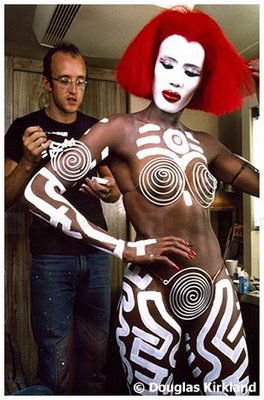 Grace Jones for her music video, opened a retail store in SoHo, selling merchandise bearing his iconic images including t-shirts, toys, posters and other objects with reproductions of his art;
  the shop closed in 2005. Haring also created advertising images for Absolut vodka and Swatch watches. By the arrival of the store, his work began reflecting more socio-political themes, such as
  racism, AIDS and
  drugs diffusion. In 1988, Haring was diagnosed with AIDS. He established the Keith Haring Foundation in 1989, its mandate being to provide funding and imagery to AIDS organizations and children's programs, and to expand the audience for Haring’s work through exhibitions, publications and the licensing of his images.
  In June 1989, on the rear wall of the convent of the Church of Sant'Antonio in Pisa, Italy, he painted the last public work of his life, a mural titled "Tuttomondo".


 http://www.haring.com/


